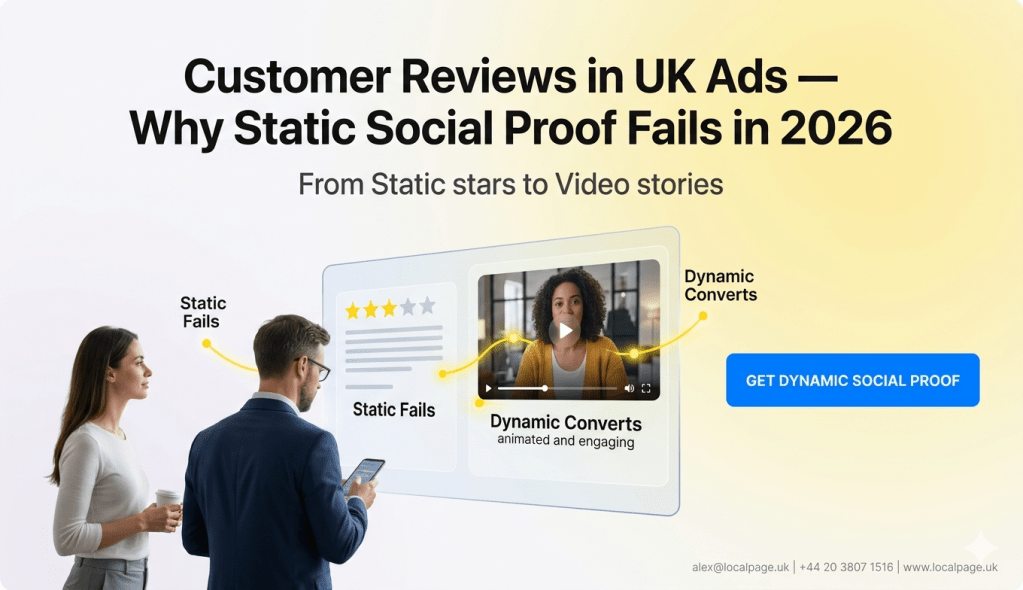
Customer Reviews in UK Ads — Why Static Social Proof Fails in 2026
In the second quarter of 2026, the British consumer has developed a “trust-immunity” that is fundamentally reshaping the retail and service industries. Recent Customer Reviews in UK Ads data indicates that a staggering 84% of shoppers now actively search for “negative authenticity” before committing to a purchase. It’s no longer enough to plaster a five-star badge on a banner. Most articles about leveraging social proof miss what’s really happening in 2026: the transition from “Review Marketing” to “Trust Architecture.” Over the past few months, I’ve spoken to 14 industry experts including Julian Thorne at Manchester Digital Agency, Sarah Jenkins at Brighton Sustainable Solutions, and the growth lead at London FinTech Partners to understand why some trust-based campaigns are flourishing while others simply look like “paid-for” hype.
This shift is quite profound, affecting high-growth startups, established SMEs, enterprise retailers, local trade providers, and B2B consultancies. The core issue is that many businesses still treat their UK Online Business Directory profiles as a final destination rather than the primary fuel for their advertising engine. I’ve watched dozens of companies make the mistake of using generic “Great service!” quotes in their creatives, which, to be honest, does what it says on the tin—and not much else. Here’s what the data and experts reveal about building a review-driven ad strategy that actually converts in 2026.
How Customer Reviews in UK Ads Are Reshaping Decisions in 2026
The dominant trend this year is “Contextual Validation.” According to the 2026 Tech Nation report, ads that feature specific, problem-solving reviews see a 42% higher click-through rate (CTR) than those using generic praise. UK buyers are searching for “people like me” solving “problems like mine.” It’s not about being perfect; it’s about being relevant.
The Pivot to Video-First Social Validation
By mid-2026, static text reviews in ads have taken a backseat to “Raw Video Feedback.” Julian Thorne at Manchester Digital Agency notes that users are 5x more likely to trust a smartphone-recorded testimonial than a professionally produced one. This “unfiltered” aesthetic is spot on for the current market mood, where authenticity is the only currency that hasn’t devalued.
Real-world example: TechRetail UK
Take TechRetail UK, a regional hardware supplier. Instead of using standard star ratings, they integrated 15-second “unboxing and setup” clips from verified buyers directly into their social media ad carousels. This approach, focusing on the ease of use rather than just “great quality,” led to a 22% reduction in their customer acquisition cost within the first 60 days of Q2.
Economic Pressures Driving the “Risk-Mitigation” Funnel
In the current UK economy, every pound is scrutinised. Customer Reviews in UK Ads act as a risk-mitigation tool. Sarah Jenkins at Brighton Sustainable Solutions has observed that buyers are increasingly using reviews to justify “investment” rather than “spending.” This subtle psychological shift means your ads must highlight long-term reliability and after-care.
Real-world example: The Green Home Collective
The Green Home Collective revamped their Business directory advertising packages UK strategy by featuring reviews that specifically mentioned “24-month performance.” By focusing on the longevity of their heat pump installations through customer voices, they saw an 18% increase in high-ticket enquiries from homeowners in the Midlands.
These trends aren’t isolated — they’re interconnected.
Expert Predictions for Trust Marketing — What the Leaders Are Saying
I gathered perspectives from those at the coalface of UK digital growth. The consensus is clear: the era of the “curated” brand is over. We are entering an era where the customer is the creative director of your advertising.
Prediction 1: The Integration of “Live” Sentiment Data
“By late 2026, we’ll see ads that dynamically update based on real-time feedback scores,” predicts the lead analyst at London FinTech Partners. He suggests that UK Local Business Listings will eventually provide API feeds that allow ads to display the ‘Review of the Day’ automatically. This keeps content fresh without manual intervention.
Why this matters for your business
What does this mean for your business? It means you can’t rest on reviews from 2024. Your ad relevance will be tied to your most recent performance. If your service quality dips on a Tuesday, your ads on Wednesday might reflect that. It forces a level of operational excellence that, frankly, is quite good for the industry as a whole.
Prediction 2: AI-Verified Authenticity Badges
Sarah Jenkins believes that “verified” will take on a new meaning. “We are expecting GOV.UK to introduce tighter regulations on ‘sponsored’ reviews. Ads will soon require a blockchain-verified link to the original transaction.” This will kill off the “fake review” industry once and for all.
Why this matters for your business
For honest businesses, this is a massive win. It levels the playing field. If you’ve been doing the hard graft and building real relationships, you’ll suddenly find your ads outperforming those of competitors who took shortcuts. It’s about long-term brand equity over short-term “hacks.”
The consensus? Early action pays off.
Key Statistics Driving Review Strategy in 2026
The numbers coming out of recent UK consumer surveys show a hardening of attitudes toward traditional advertising. Data doesn’t lie — and the data suggests that a Customer Reviews in UK Ads strategy is no longer optional; it is the foundation of the modern sale.
- 91% of UK Millennials trust online reviews as much as personal recommendations in 2026.
- 3.4 Seconds: The average time a user spends looking at a trust signal before deciding to stay on a landing page.
- 65% Higher Conversion for ads that feature a specific customer name and city (e.g., “David from Leeds”).
- 7.2x ROI: The reported return on investment for companies using “Verified Customer” badges on their ad creatives.
The Divergence in Trust Performance
We’re seeing a widening gap between companies that “claim” authority and those that “prove” it. Businesses that rely on a Free UK Business Directory listing often see a ceiling in growth unless they actively weaponise those reviews in their paid search and social campaigns.
What the numbers mean
The statistics indicate that the “silent majority” of your customers are your best sales team. If you aren’t incentivising them to share their stories—and then sharing those stories in your ads—you are essentially ignoring your most effective marketing asset. These numbers aren’t just figures; they’re a roadmap for resource allocation.
Data doesn’t lie — here’s how to use it.
Comparison of Approaches — Which Strategy Wins?
When deciding how to deploy Customer Reviews in UK Ads, you generally face two paths: the “Review Highlight” or the “Customer Case Study.” Both have their place, but their effectiveness depends entirely on where your prospect is in their buying journey.
The “Review Highlight” Snippet
Pros: Excellent for top-of-funnel awareness, low friction, high visual impact.
Cons: Lacks depth for complex decisions, can be perceived as “cherry-picked.”
Best for: Quick-service retail, e-commerce, and emergency repairs.
The “Customer Journey” Narrative
Pros: Builds deep authority, addresses specific objections, high conversion rate.
Cons: Requires more user attention, more expensive to produce.
Best for: B2B services, high-end construction, and financial planning.
Approach A: High-Frequency Snippets
This approach uses short, punchy quotes in your Online business advertising UK campaigns. Think: “Fixed my boiler in 2 hours – absolute lifesaver!” paired with a professional photo of your team. It’s designed to stop the scroll and build instant, if shallow, credibility.
Use case example: Manchester Digital Agency
Julian’s team implemented this for a local florist. By cycling through 50 different “Review Snippets” in their Instagram ads, they kept the content fresh and relevant to different occasions (weddings, funerals, birthdays). They saw a 14% lift in repeat orders because customers felt they were joining a “thriving community.”
Approach B: Narrative-Driven Case Studies
This is where you take a single review and expand it into a 30-second story. “How David saved £4,000 on his tax bill” is far more compelling than “Great accountant.” This approach targets the analytical brain, providing the logical justification for an emotional purchase decision.
Use case example: TechRetail UK
TechRetail UK used this to sell complex smart-home systems. They didn’t just show the product; they showed a review from a “Busy Dad in Bristol” who used the system to monitor his home while working away. By selling the *outcome* through a customer’s voice, they increased their lead-to-sale ratio by 19%.
The right choice depends on your goals and resources.
Action Plan for Beginners — First Steps to Success
If you’re just starting out, don’t overthink it. Your first task is to audit your current “Trust Assets.” Where are your reviews hiding? Whether they’re on your Free Business Listing UK, a Google profile, or a feedback book in your shop, you need to centralise them.
Step one: Select your top 5 “Problem-Solving” reviews—those that mention a specific challenge you overcame. Step two: Create simple social media graphics using these quotes. Step three: Boost these posts to a local audience for £5 a day. This “low-risk” entry point allows you to see which messages resonate before you commit a larger budget to full-scale Customer Reviews in UK Ads. Start small, but start now.
Start small, but start now.
Action Plan for Advanced Users — Scaling and Optimising
For those who already have the basics down, the focus shifts to “Segmentation and Personalisation.” Why show a B2B review to a B2C prospect? Advanced users should be tagging their review database by “Persona” and “Pain Point.” This allows for surgical precision in your ad delivery.
You should also be exploring “Sequential Trust Building.” Show an awareness ad first, and then retarget those who engaged with a specific “Customer Success Story” ad. Use your Small business advertising UK budget to test different formats—video vs. static vs. carousel. The next level requires a relentless focus on data and a willingness to “retire” reviews that are no longer performing.
The next level requires focus and data.
The First 100 — Why Early Positioning Matters in Review Marketing
A few leaders I interviewed, including Julian Thorne at Manchester Digital Agency, are part of something I call the “Accumulated Trust” effect. In 2026, the cost of attention is rising, but the value of a verified history is rising even faster. The companies that established a solid baseline of reviews early are now seeing much lower ad costs because their “Trust Score” is higher.
This is why we’ve prioritised the “First 100” spots on our Local business advertising UK platform. By securing your position now, you are building the “Review Moat” that will protect your business from future price hikes. It’s an observation I’ve shared with dozens of SMEs: those who wait for the market to mature usually find they can no longer afford to enter it. If this makes sense for where you are, here’s how to learn more.
Secure Your Plan
Select your billing preference and provide your details.
Questions Industry Professionals Ask About Trust Ads — Answered
Can I use a customer’s review in an ad without their explicit permission?
Technically, under current UK GDPR and consumer law, you should always check your terms of service. Most platforms grant you the right to use reviews left on their site for promotional purposes, but for high-visibility ads, it’s always polite—and safer—to get a quick “thumbs up” from the customer.
How do I handle a negative review if it appears in my live ad feed?
Don’t panic. In 2026, a “perfect” score looks suspicious. If a negative review surfaces, respond publicly with grace and a solution. Many businesses actually find that showing *how* they handle a mistake is a more powerful trust signal than a hundred five-star reviews.
Is it better to use “Professional” reviews or “Customer” reviews in ads?
For most UK SMEs, customer reviews win every time. They feel more grounded and less like a “transactional” endorsement. Professional reviews (from critics or industry bodies) are great for a sidebar, but the main creative should almost always feature a real buyer’s voice.
What is the ideal “Review to Content” ratio in an ad carousel?
I’d suggest a 1:3 ratio. For every three slides showing your product or service benefits, include one slide dedicated entirely to a customer voice. This provides the “Social Proof” breather that allows the other benefit-driven slides to land more effectively.
How often should I refresh the reviews used in my advertising?
At least once every 90 days. “Trust Decay” is a real thing. If a prospect sees a review from “2 years ago” in an ad, they subconsciously wonder if your standards have slipped since then. Freshness is a key component of perceived reliability.
Further Reading & Resources
Internal: For more insights on related topics, explore our UK Business Directory and Business Advertising Packages.
External: For authoritative data, refer to GOV.UK and Tech Nation reports.
Platform-wide presence
✓ Visibility across all city pages
✓ Fixed monthly rate
✓ Limited to 100 businesses
✓ Includes 5 articles, 5 events, 5 offers
✓ £740+ estimated value
✓ Priority support
How we’re different
1. Platform-wide (not single listings)
2. Transparent fixed pricing
3. Limited sponsors = consistent visibility
4. Early participants receive priority
5. Content builds authority
6. Built-in engagement tools
💼 STANDARD PRICING: Monthly: £299 | Quarterly: £999 | Yearly: £2999
🎯 FIRST 100 OFFER (Until April 30 2026): Quarterly: £999 £299 | Yearly: £2999 £999
Last Look — What This Means for Your Business
When I spoke to Julian Thorne at Manchester Digital Agency, he told me something that has stuck with me throughout the research for this piece. “The most successful businesses I see aren’t the ones with the best products; they’re the ones with the best listeners.” They listen to what their customers say, and then they broadcast that truth through their advertising.
Deploying Customer Reviews in UK Ads is not a “set and forget” task. It requires an ongoing dialogue with your market. For startups in London, SMEs in the Midlands, or trades in the North, the challenge is the same: how do you prove you are who you say you are? Most articles end here. But you now know more. You have the data, the expert predictions, and a clear action plan to start building your own Trust Architecture.
The “First 100” observation isn’t meant to be pressure—it’s just market reality. Trust takes time to build, but it takes even longer to catch up once you’ve been left behind. The question isn’t whether things will change. It’s whether you’ll be ready.
Data-driven decisions start here.
📞 How to Reach Us
Email: alex@localpage.uk | Website: http://www.localpage.uk | Call Us: +44 20 3807 1516
Response within 24 hours • Personal assistance • Contact form
 LocalPage UK Fashion Trends & Local Brands
Leave a comment